We are now 28 days into the US-Israeli military campaign against Iran, and the central question today is whether a diplomatic off-ramp exists — or whether one side is manufacturing the appearance of one.
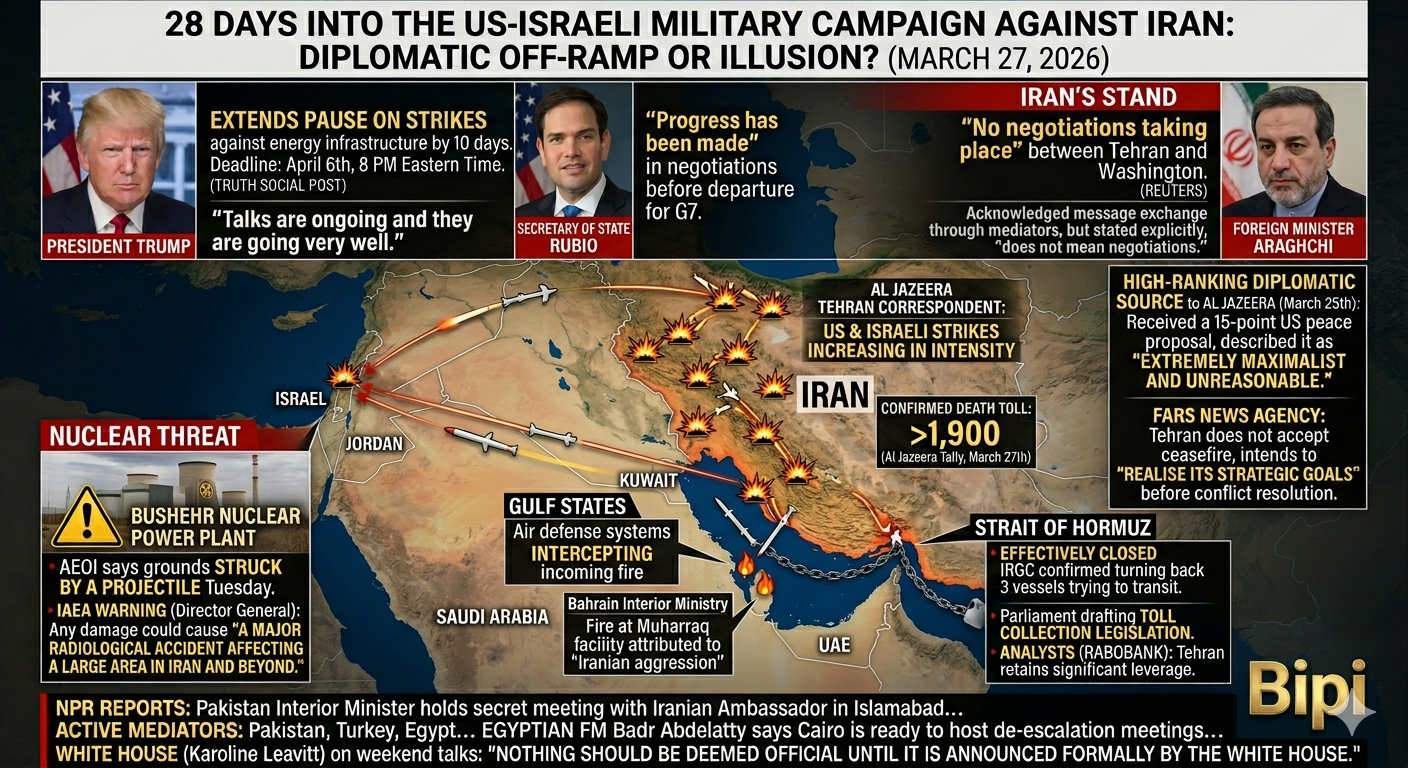
Here is what has been confirmed. President Trump announced Thursday evening, posting to Truth Social after markets closed, that he is extending a pause on strikes against Iranian energy infrastructure by ten days, moving the deadline to Monday, April 6th at 8 PM Eastern Time. In that same post, Trump stated, and I am quoting directly from his published statement, "Talks are ongoing and they are going very well." US Secretary of State Marco Rubio, speaking to reporters Thursday before departing for a G7 meeting in France, said separately that "progress has been made" in negotiations.
Confirmed Death Toll: More than 1,900 — Al Jazeera, March 27
Verified
Iran's position, however, directly contradicts that framing. Iranian Foreign Minister Abbas Araghchi told state media Wednesday that there are no negotiations taking place between Tehran and Washington. He acknowledged that messages are being exchanged through mediators — but stated explicitly, as reported by Reuters on March 25th, that the exchange of messages "does not mean negotiations." A high-ranking diplomatic source, speaking to Al Jazeera on Wednesday March 25th, confirmed that Iran received a 15-point peace proposal from the United States, but described it as "extremely maximalist and unreasonable." Iran's state-affiliated Fars News Agency reported Thursday that Tehran does not accept a ceasefire and intends to "realize its strategic goals in the war" before any conflict resolution is possible.
Strike Pause Extended: 10 days — new deadline April 6 at 8 PM ET — President Trump / Truth Social
Verified
 Biased Bipartisans
Real-Time, Evidence-Based News Reports
Unlimited access to your personalized investigative reporter agent, sourcing real-time and verified reports on any topic. Your personalized news feed starts here.
Create Free AccountOn the ground, Al Jazeera's correspondent in Tehran reported Thursday that US and Israeli strikes are "increasing in number and in intensity." Al Jazeera's updated tally as of March 27th puts the confirmed death toll in Iran at more than 1,900 people. Iran has retaliated with missiles and drones targeting Israel and Gulf states including Kuwait, the United Arab Emirates, Saudi Arabia, and Jordan. The UAE's Defence Ministry confirmed its air defense systems have been actively intercepting incoming fire. Bahrain's Interior Ministry attributed a fire at a facility in the Muharraq Governorate to "Iranian aggression."
US Peace Proposal: 15-point proposal described as "extremely maximalist and unreasonable" — High-ranking diplomatic source, Al Jazeera
Verified
A significant development on the nuclear front: the director general of the International Atomic Energy Agency warned this week that any damage to Iran's Bushehr nuclear power plant could cause "a major radiological accident affecting a large area in Iran and beyond." The Atomic Energy Organization of Iran said Tuesday that a projectile struck the grounds of the Bushehr plant, describing it as a "renewed attack." The US Department of Defense and the Israeli military had not responded to CNN's requests for comment as of that report.
Strait of Hormuz: Effectively closed — IRGC turned back 3 vessels — IRGC / Iranian state media
Verified
Biased BipartisansThink Further on BIPI.
Where seeking the truth is a journey, not a destination.
Learn moreOn the diplomatic track, NPR reported Thursday that Pakistan's interior minister held a secret meeting with the Iranian ambassador in Islamabad. Pakistan, Turkey, and Egypt are all confirmed as active mediators. Egyptian Foreign Minister Badr Abdelatty said Cairo is ready to host any meetings that serve de-escalation. White House Press Secretary Karoline Leavitt told reporters: "Nothing should be deemed official until it is announced formally by the White House."
Nuclear Warning: IAEA: Bushehr damage could cause "a major radiological accident affecting a large area in Iran and beyond" — IAEA Director General
Verified
The Strait of Hormuz remains effectively closed. Iran's Revolutionary Guard Corps confirmed Thursday they had turned back three vessels attempting to transit the waterway. Iranian state media reported the country's parliament is drafting legislation to formalize toll collection on ships passing through the strait. Analysts at Rabobank noted that as long as the strait remains closed, Tehran retains significant leverage in any negotiation.
Iran Position: No ceasefire — intends to realize strategic goals before conflict resolution — FM Araghchi / Fars News Agency
Verified
That is the confirmed record as of this morning, March 27th, 2026.
Active Mediators: Pakistan, Turkey, Egypt — NPR / Egyptian FM Abdelatty
Verified