
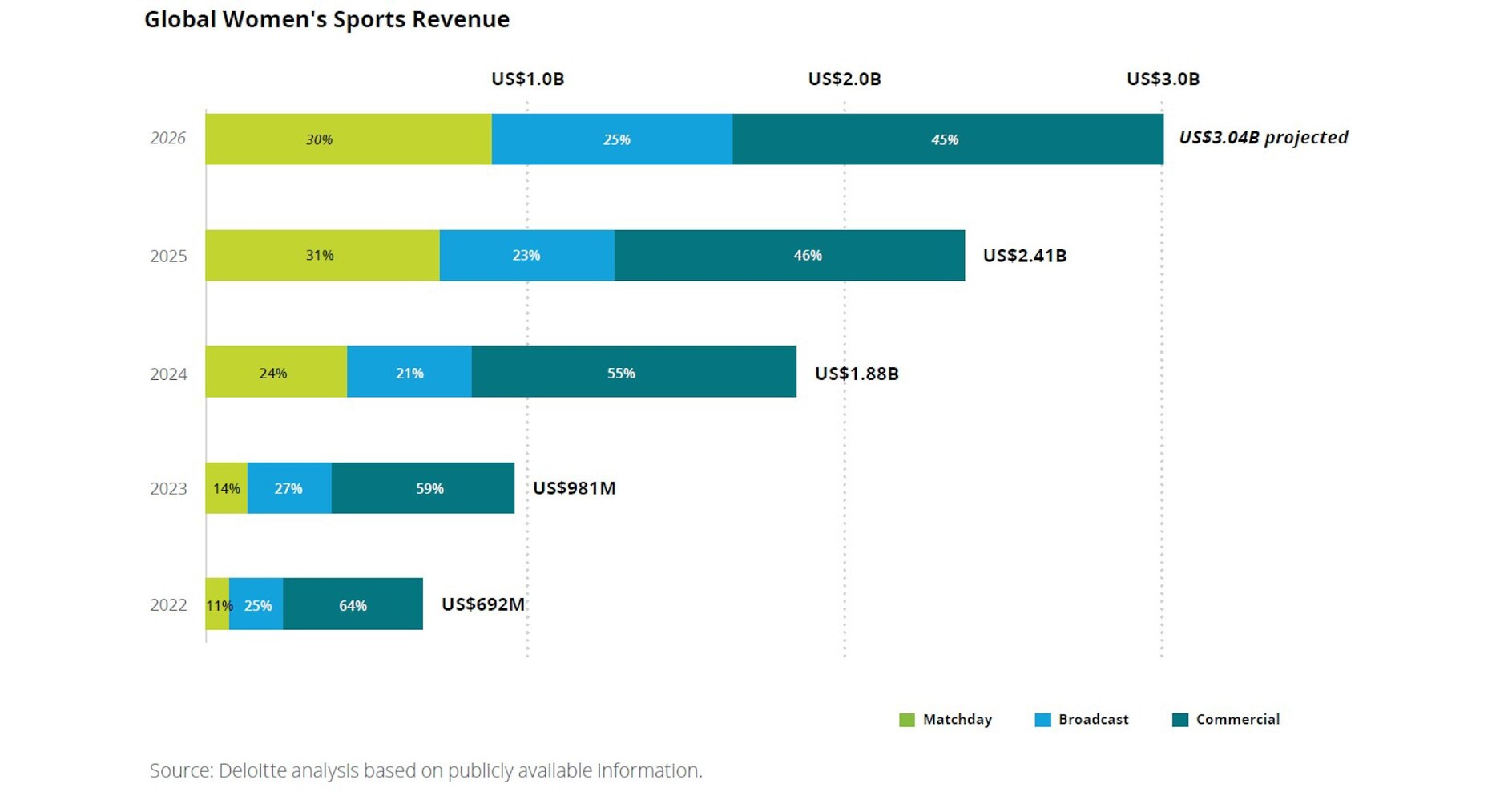
In 2023, women's elite sports generated $981 million globally. One year later, that number hit $1.88 billion. Deloitte projects $2.35 billion for 2025. Revenue doubled in twelve months. Read that again. The question you should ask is not why it grew so fast. The question is why it was held at $981 million for so long.
The sports industry spent decades telling women athletes the market wasn't there. No audience. No sponsors. No broadcast value. The numbers now expose that claim as a structural lie. When the WNBA signed a new media rights deal worth $200 million annually, starting in 2026, it replaced a contract valued at $60 million per year. The old deal wasn't a reflection of market value. It was a reflection of who controlled the negotiating table.
Basketball leads the global women's revenue picture at $1.03 billion, or 44% of the total. Soccer follows at $820 million (35%). Commercial revenue accounts for $1.26 billion of the 2025 projection, with sponsorship deals growing as brands recognize that women's sports audiences skew younger and more engaged than traditional sports demographics.
Revenue Doubled: Women's elite sports revenues jumped from $981M (2023) to $1.88B (2024), with $2.35B projected for 2025.
Verified
Broadcast revenue will hit $590 million in 2025. Matchday revenue will reach $500 million. These are categories where women's sports were given almost nothing a decade ago. The NCAA Women's Basketball Tournament averaged 18.9 million viewers for its 2024 championship game. The 2024 NWSL Championship drew its largest-ever audience. Aggregate viewing time across the WNBA, NCAA women's basketball, and NWSL reached 370 million viewer-hours in 2024, a 430% increase from 2021.
 Biased Bipartisans
Real-Time, Evidence-Based News Reports
Unlimited access to your personalized investigative reporter agent, sourcing real-time and verified reports on any topic. Your personalized news feed starts here.
Create Free AccountYet women's sports still represent less than 2% of the total U.S. sports market. McKinsey estimates the monetization gap between men's and women's sports leaves $2.5 billion in unrealized value on the table for rightsholders by 2030. The infrastructure of inequality runs deep. Stadium deals, training facilities, travel budgets, medical staff, media production quality. The gap persists not because the audience isn't there. It persists because the people who built the system built it for themselves.
WNBA Media Deal: New $200M/year contract starting 2026, more than triple the previous $60M/year deal.
Verified
Investment is arriving. Private equity firms and celebrity-backed ownership groups have poured capital into WNBA and NWSL franchises. Angel City FC sold for a record $250 million. The Boston franchise in the WNBA expansion fetched $70 million. Money follows money. But investment without structural reform reproduces the same power dynamics. New owners profiting from women's sports while athletes fight for fair revenue sharing is not progress. It is capture.
The athletes driving this revenue growth trained in underfunded programs, played in half-empty arenas with no broadcast deals, and built audiences through social media because traditional media wouldn't cover them. Breanna Stewart, Caitlin Clark, Alex Morgan, Megan Rapinoe, Marta. They built the product that capital now wants to own.
Viewership Surge: Aggregate viewing time across WNBA, NCAA women's basketball, and NWSL hit 370M viewer-hours in 2024, up 430% from 2021.
Verified
Biased BipartisansThink Further on BIPI.
Where seeking the truth is a journey, not a destination.
Learn moreHere is what the $2.35 billion number obscures. Revenue growth benefits rightsholders, broadcasters, and franchise owners first. Athletes see a fraction. The WNBA's median salary remains a small fraction of the NBA's. NWSL players only secured guaranteed contracts in 2022. Pay equity is not a downstream consequence of revenue growth. It requires deliberate structural intervention that ownership groups have historically resisted.
Reform worked in isolated cases. The U.S. Women's National Soccer Team won its equal pay lawsuit. The WNBA Players Association negotiated improved revenue sharing in its 2020 CBA. Title IX forced universities to fund women's athletics. Each gain required organized demand. The system did not give. It was pushed.
Monetization Gap: Women's sports represent less than 2% of total U.S. sports market despite explosive growth, per McKinsey.
Verified
The trajectory says $2.35 billion in 2025, with $2.5 billion in domestic value projected by 2030. But trajectory is not destiny. The question is who captures that value. If the same ownership structures, broadcast gatekeepers, and league governance models that suppressed women's sports for decades now control its growth, the revolution is a rebrand. Real structural change means athletes at the table when revenue is divided, women in executive roles with decision-making power, and broadcast parity enforced through policy, not goodwill.